


Por Pablo Rumel
“Y vi que los carniceros al tercer día
se están matando entre ellos perpetuamente
Tened cuidado señores los carniceros
con los terceros días de las terceras noches.”
Oscar Hahn, Reencarnación de los carniceros
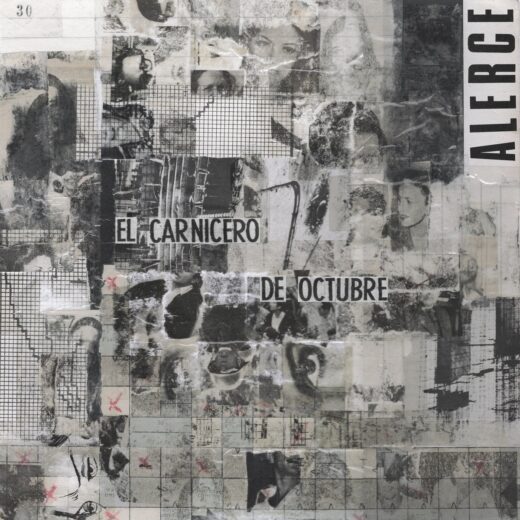
«El Carnicero de Octubre» es la cuarta placa de los valdivianos Alerce: un disco ecléctico y de excelente factura que aborda, sin metáforas rebuscadas ni dobles lecturas, lo acontecido durante el estallido social en Chile durante 2019. Se oye fresco y diverso dentro de su propia matriz musical; también experimental: dialoga con estilos reconocibles como el rock progresivo, el post-rock o el shoegaze, y configura una identidad única.
A la instrumentación clásica del rock, los valdivianos suman metalófonos, cellos, vientos, y como elemento más presente en las composiciones, grabaciones de voces tomadas directamente de la contingencia. Con ellas recrea parajes del acontecer a través de un collage sonoro que convierte la experiencia en un documento atemporal de una época concreta.
El disco fractura la linealidad y la progresión clásica de los álbumes conceptuales. A través de cada canción, se abre a espacios de coordenadas expandidas y móviles, y vuelca acordes y estructuras que se derraman en otras formas, creando una amplia red sonora: un vasto tejido fluvial o, mejor, arbóreo, si queremos aprovechar la imagen del alerce, único por su longevidad y la durabilidad de su madera.
«Crónica del inicio de un murmullo» arranca con el sonido brillante de un metalófono, acompañado de teclados suaves y una percusión calma. Destaca el excelente trabajo coral en las voces, que genera líneas melódicas contrapuntísticas; el efecto se potencia con la voz delicada de Camila Bórquez, que puede sonar en diversos registros, a veces leve y grácil como el extremo de un sauce orillando el río, o crepitante, como un árbol abrasado por el fuego.
La canción de inicio está muy bien escogida, pues deja claro que no será un viaje lineal, sino uno atravesado por cambios de marcha y quiebres rítmicos. Su sonido se despliega entre capas disonantes y distorsionadas, con la intensidad del post-rock y el shoegaze en las guitarras. Jorge Cortés es responsable de los fraseos abrasivos, las texturas expansivas y los parajes hipnóticos; además, aporta su pericia con el corno, instrumento poco usual que da a la canción un matiz casi sagrado.
«El carnicero de octubre» tiene una vibra distinta: agresividad contenida. La canción que da título al trabajo muestra a Alerce con una habilidad compositiva bien lograda; sus integrantes crean capas sonoras que se superponen al archivo expuesto, el del carnicero de octubre —quien tuvo un trágico final en el lago Ranco—. Además, utilizan diferentes texturas vocales, que oscilan entre la limpieza y los efectos de megáfono. Estamos ante una canción que atraviesa parajes de marchas marciales y diversas intensidades rítmicas: las cuerdas pasan de arpegios lentos y limpios a rasgueos rápidos con efectos tipo reverb y flanger.
Hay que mencionar el aullido de Camila, casi a mitad de la canción: un fraseo desgarrador que más allá de la catarsis, funciona como un quiebre al interior de una composición que viaja por diversos registros, pero no como una batidora sin centro de gravedad. Mantiene la pulsación y la firmeza de una propuesta autoconsciente, que marca y muestra un camino (y a un culpable), pero deja espacios sonoros para representar lo irreal y la duermevela, ese estado a medio camino entre el sueño profundo y la vigilia.
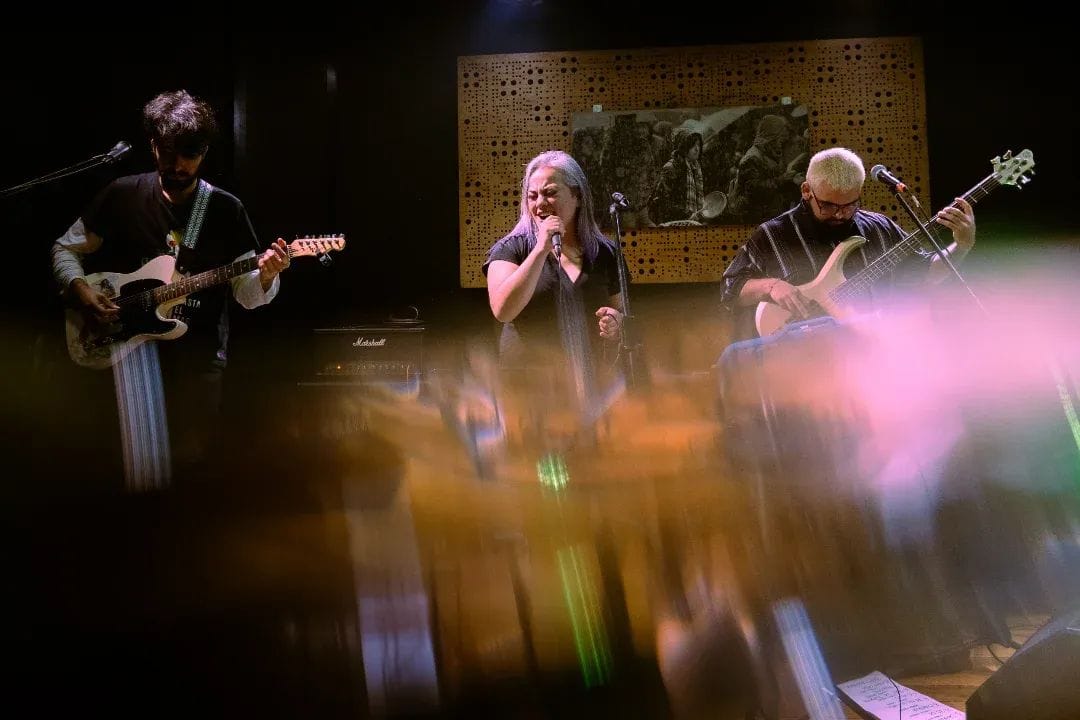
La responsabilidad de que no estemos ante un disco desbocado, pese a que sí corre riesgos con estructuras poco tradicionales, recae en el talento del baterista Samuel Carreño. Sabe quebrar las rítmicas tradicionales con síncopas y polirritmias, acentuando la profundidad espaciada de las cuerdas cuando entran en pasajes sostenidos. «25 OC» es una prueba irrefutable de su talento: entra con un juego ágil de baquetas y demuestra una habilidad jazzística envidiable, mientras mantiene el pulso sonoro que demandan unas voces fantasmáticas, casi liminales, entre un punteo de guitarra lento y repetitivo. Las líneas de bajo, conducidas por Martín Carreño, bien marcadas y profundas, avanzan y se repliegan entre estribillos sublimes y oníricos.
«País de tuertos» vuelve a ese registro involuntariamente surreal, con elementos del soul y el jazz, sumando quiebres rítmicos propios del progresivo. La composición se despliega mediante la acumulación de recursos: un riff funcional permite que el resto de los músicos planee alrededor de esta construcción, casi como en una jam session. Ingresan nuevos registros sonoros de archivo y Camila Bórquez, una vez más, nos regala fraseos fantasmales con notas largas y sostenidas, además de nuevas secciones contrapuntísticas que refuerzan las ondas espectrales de la composición.
«Somos minoría, pero pocos no somos» coquetea con la balada oscura: solos disonantes y pequeños silencios transitan hacia melodías espaciales. La canción dura exactamente tres minutos y treinta y tres segundos, número sugestivo si recordamos que durante el primer gobierno del «carnicero de octubre», significó el rescate de los 33 mineros; una suerte de gesta televisada que con el paso de los años se diluyó en el olvido.
Ya en el tramo final, nos encontramos con «En el nombre de Gladys», una pista construida con un swing muy improv a cargo de la percusión y el bajo, que van libres, por la suya, entre fragmentos de discursos de la exdirigente comunista Gladys Marín, tomados de distintos momentos: algunos atravesados por la crítica social y la efervescencia del momento; otros, por observaciones respecto del quehacer político de aquellos años.
«Yo no vi nada» se empina hacia los ocho minutos; se trata de la composición más larga del disco y, por lo mismo, experimenta diversas progresiones en su estructura. Inicia en calma, con sonoridades espaciadas, propias de la psicodelia, emergiendo una estructura percusiva que emerge del golpe suave de toms y cajas, casi de manera lateral, para avanzar hacia una centralidad cada vez mayor. La técnica del collage sigue presente, pero los registros han dejado de ser limpios: se oyen con un ligero eco, como si provinieran de fuentes ajenas a este mundo. La sección final crea patrones de cuerdas arrastrados, con una rítmica acelerada in crescendo, para rematar en sonoridades que recuerdan mucho al space rock setentero.
El viaje termina con el corte «La burla del asíntota»: los teclados cobran mayor protagonismo y dejan de ser un mero elemento ornamental, mientras avanzan entre guitarras limpias, cortes abruptos con guitarras distorsionadas y percusiones sincopadas. ¿Y qué podría esconder el título de la canción? Matemáticamente, una asíntota es una línea recta a la que una curva se acerca de forma continua e infinita, reduciendo la distancia entre ambas casi a cero, pero sin llegar a tocarla jamás. Metafóricamente, representa un vínculo o una meta inalcanzable (como un amor platónico o la perfección): dos partes comparten una cercanía cada vez más intensa, pero un límite invisible les impide concretar el encuentro final.
Y esto último suele ser trágico. O divertido. Quizá irónico La canción actúa casi como un epílogo intenso, una fuga hacia la nada coronada por un silencio. Camila se le oye en plena forma: canta al borde de la furia e intercala parajes vocales con los coros de manera magistral, creándose una sinergia breve entre los músicos, que muestran sin ambages sus individualidades, pero también su talento grupal.
El cierre solo puede ser un silencio, porque las palabras nunca bastan. Más que aspirar a una línea dogmática o programática, Alerce transmite —si se permite el neologismo— el acto de audiografiar un momento específico de la historia chilena. Y lo hace con creces, de manera honesta y profunda.
Veredicto: la fusión im/posible entre lo íntimo y lo público
No sabemos cómo se oirá «El carnicero de octubre» en el futuro: un registro tan apegado a la contingencia quizá se transforme cuando sus actores hayan envejecido o desaparecido, y los mapas que nos gobiernan se hayan transfigurado en otra cosa.
Como en toda historia real, siempre quedan residuos: hilos sueltos con los que volver a enhebrar la aguja. Alerce hace sonar juntos dos polos irreconciliables. De un lado, lo íntimo: cuerdas que van de la resonancia espectral a lo chamánico y el impulso —el animus, la inspiración— de incorporar voces reales, tomadas de registros que nunca se hicieron para formar parte de una composición musical. Del otro, lo público, territorio más propio del punk, el thrash o la canción de protesta, encuentra aquí su lugar. El disco invita a la libre interpretación, pero no admite el doble rasero: Alerce sí señala al carnicero de octubre.
REVIEW: ALERCE «EL CARNICERO DE OCTUBRE» (2026)
“The October Butcher” is the fourth record by Valdivia band Alerce, an eclectic album of fine craft that addresses what happened during Chile’s 2019 social outburst, without convoluted metaphors or double meanings. It sounds fresh and varied within its own musical framework, and experimental too. It converses with familiar styles such as progressive rock, post rock and shoegaze, shaping a unique identity.
Alongside the classic instrumentation of rock, the band from Valdivia adds metallophones, cellos and wind instruments. The most prominent element in the compositions is a set of voice recordings captured directly from events as they unfolded. Through them, the band recreates landscapes of those events in a sonic collage that turns the experience into an atemporal document of a specific era.
The record fractures the linearity and conventional progression of concept albums. Through each song, it opens onto spaces with expanded, shifting coordinates, pouring chords and structures into new forms and creating a broad sonic web: a vast riverine weave or, better, an arboreal one, if we want to draw on the image of the alerce tree, unique for its longevity and the durability of its wood.
“Crónica del inicio de un murmullo” begins with the bright sound of a metallophone, accompanied by soft keyboards and calm percussion. The vocals stand out for their excellent choral work, creating contrapuntal melodic lines. The effect is heightened by Camila Bórquez’s delicate voice, which moves through different registers, sometimes light and graceful as the tip of a willow at the river’s edge, sometimes crackling like a tree scorched by fire.
The opening song is very well chosen. It makes clear that this will not be a linear journey, but one marked by shifts in gear and rhythmic breaks. Its sound unfolds through dissonant, distorted layers, with the intensity of post rock and shoegaze in the guitars. Jorge Cortés is responsible for the abrasive lines, expansive textures and hypnotic passages. He also brings his skill on the horn, an uncommon instrument that gives the song an almost sacred quality.
“El carnicero de octubre” has a different feel, one of contained aggression. The title track shows Alerce’s finely honed compositional skill. The band builds layers of sound over the archival recording of the October butcher, who met a tragic end at Lake Ranco. The vocals shift between a clean sound and megaphone effects. This song moves through passages of martial marches and changing rhythmic intensities. The strings shift from slow, clean arpeggios to fast strumming with reverb and flanger effects.
Camila’s howl, almost halfway through the song, deserves a mention. It is a devastating phrase that goes beyond catharsis, breaking open a composition that travels through different registers without turning into a blender with no center of gravity. The song holds on to the pulse and firmness of a self aware approach. It marks a path, and points to someone responsible, while leaving sonic space for the unreal and for that drowsy state between deep sleep and wakefulness.
The reason this is not a runaway record, despite its risks and unconventional structures, lies in drummer Samuel Carreño’s talent. He knows how to break conventional rhythms with syncopations and polyrhythms, emphasizing the spacious depth of the strings when they enter sustained passages. “25 OC” is irrefutable proof of his talent. It opens with nimble stick work and displays an enviable jazz sensibility, while holding the pulse demanded by ghostly, almost liminal voices, set against slow, repetitive guitar picking. The bass lines, played by Martín Carreño, are clearly marked and deep, advancing and retreating between sublime, dreamlike choruses.
“País de tuertos” returns to that unintentionally surreal register, with elements of soul and jazz, along with rhythmic breaks drawn from progressive rock. The composition unfolds through an accumulation of resources. A functional riff lets the other musicians circle around its structure, almost as in a jam session. New archival recordings enter, and Camila Bórquez once again gives us ghostly phrases with long, sustained notes, along with new contrapuntal sections that deepen the song’s spectral waves.
“Somos minoría, pero pocos no somos” flirts with the dark ballad. Dissonant solos and small silences move toward spacious melodies. The song lasts exactly three minutes and thirty three seconds, a suggestive number considering that, during the first government of the “October butcher,” it came to signify the rescue of the 33 miners, a kind of televised triumph that faded into oblivion over the years.
In the final stretch, we come to “En el nombre de Gladys,” a track built around a highly improvised swing led by percussion and bass, which roam freely on their own among fragments of speeches by former Communist leader Gladys Marín. The excerpts come from different moments. Some are marked by social criticism and the fervor of the time, others by reflections on the politics of those years.
“Yo no vi nada” stretches toward eight minutes. It is the longest composition on the record and, for that reason, moves through several structural progressions. It begins calmly, with spacious sounds drawn from psychedelia. A percussion structure rises from the soft taps of toms and snare drums, almost from the sidelines, before taking on an increasingly central role. The collage technique remains, but the recordings are no longer clean. They carry a slight echo, as though they came from sources beyond this world. The final section builds dragging string patterns over a steadily accelerating rhythm, ending in sounds that strongly recall 1970s space rock.
The journey ends with “La burla del asíntota.” The keyboards take on a greater role, moving beyond the ornamental part they played in other songs as they weave through clean guitars, abrupt bursts of distorted guitar and syncopated percussion. What might the song title conceal? Mathematically, an asymptote is a straight line that a curve approaches continuously and infinitely, bringing the distance between them close to zero without ever touching it. Metaphorically, it represents an unattainable bond or goal, like platonic love or perfection. Two sides draw ever closer, yet an invisible boundary keeps them from meeting at last.
And that last part is often tragic. Or funny. Perhaps ironic. The song acts almost as an intense epilogue, a flight into nothingness crowned by silence. Camila sounds in top form. She sings on the edge of fury and masterfully interweaves vocal passages with the choruses, creating a brief synergy among the musicians. They reveal their individual strengths without reserve, along with their collective talent.
The only possible ending is silence, because words are never enough. Rather than pursuing a dogmatic or programmatic stance, Alerce conveys, if the neologism is allowed, the act of audiographing a specific moment in Chilean history. It does so with distinction, honestly and deeply.
Verdict: The impossible and possible fusion of the intimate and the public
We do not know how “El carnicero de octubre” will sound in the future. A record so closely tied to current events may change as its actors grow old or disappear, and the maps that govern us turn into something else.
As in every true story, there are always remnants: loose threads with which to thread the needle again. Alerce brings two irreconcilable poles together in its music. On one side is the intimate, with strings that move from spectral resonance to the shamanic, and the animus, the inspiration to bring in real voices from recordings never made to become part of a musical composition. On the other is the public, a territory more at home in punk, thrash or protest song, which finds its place in this record. The album invites free interpretation, but allows no double standard. At the end of the day, Alerce does point to the October butcher.
Este artículo ha sido visitado 1 veces, de las cuales 1 han sido hoy


Más del autor
 BETWEEN THE BURIED AND ME: THE BLUE NOWHERE (2025)Por Claudio Miranda El lanzamiento más reciente de los de Raleigh registra el lugar 11 en…
 THE HAUNTED – SONGS OF LAST RESORT (2025)Por Claudio Miranda Son 30 años cerrados los que The Haunted lleva reflejando el momento que…
 MASTERPLAN -METALMORPHOSIS (2026)Por Pablo Rumel Séptima larga duración de los alemanes: en líneas generales se trata de un…